
ROPE CURTAIN TIE BACKS
We offer Rope Tie backs in a choice of knotted designs and methods of attachment. The Button and Loop style tie backs have an eye splice at one end and a stopper knot - such as the Monkey Fist at the other end acting as the button. This gives the option to draw the tie back on the curtain independently or to pull it back over a single hook.
An alternative type of curtain tie back has eye spliced loops at each end and is designed to drop onto wall fittings or window hooks. Both the Carrick Bend and Barrel Knot tie backs are made like this, although they can also be adapted to work as button and loop tie backs - see below.
Rope tie backs are hand made to measure with the circumference (embrasse) taken to be between the top of the loop and the neck of the Monkey Fist knot or between the top of each loop on tie backs designed for wall or window fittings.
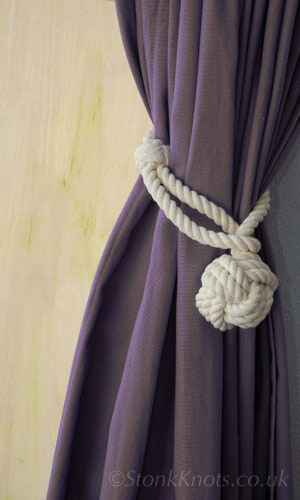
Monkey Fist Rope Tie-back
A short Monkey Fist button and loop rope tieback, such as the cotton one shown above, has an embrasse of 36cm (14 inches), to form a single turn around the curtain. It is made from 8mm diameter unbleached cotton rope and features a loop and button type fastening. The Monkey fist ball knot at one end is threaded through and secured by an eye splice (the loop) - which is made of the same length of rope, and decorated with a manrope knot at the joined end of the splice.
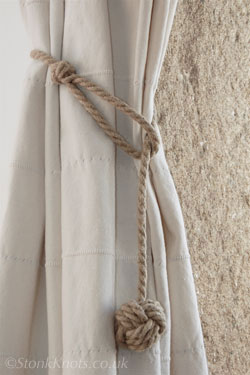
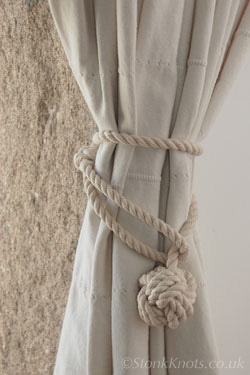
The two images above illustrate monkey fist tie backs in hemp rope with embrasses of 71 cm (28 inches). These allow for a double turn around the curtain or for a single turn on a long setting for the knot, and could also be used around a thicker curtain.
You can easily measure your requirements using a piece of string to set up a mock tieback on your curtain.
We offer a similar design as a Monkey Fist lightpull - a description of how the knot is worked and an example in black nylon is shown on our rope light pulls page.
Carrick Bend Tie-back
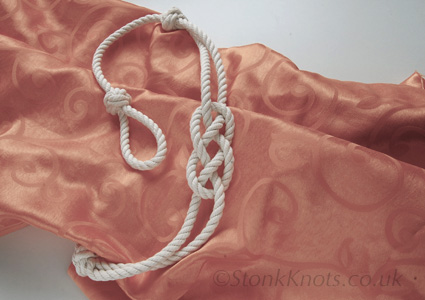
This cotton rope tie back features the beautifully proportioned Carrick Bend whose over and under weave is typical of many Celtic knot symbols. In a different setting the same knot can give a classic nautical look.
A bend is used to unite two ropes, and the Carrick Bend is not only the most symmetrically perfect, but also one of the strongest; this knot was traditionally used to join two heavy hawsers together and the ends were usually whipped (bound) to the standing part.
In this tie back version, the traditional design has been adapted with decorative manrope knots replacing the whipped ends. A manrope knot is also tied in at each of the loop ends, to tidy away the strands from the eye splices. The Carrick Bend Rope Tie back has a standard embrasse of 36cm (14 inches) but can also be made at a length to suit.
- Carrick Bend tie-back -
Standard embrasse: 36cm (14 inches)
Hemp, Cotton or Black Polyester
£35 each
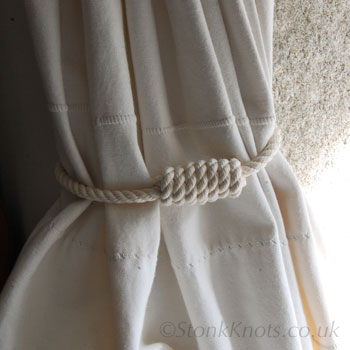
Barrel Knot Tie-back
A Barrel Knot is normally used as a bend to join two ropes together, but in this case it is worked in a single rope to form a raised section as a simple central feature of this tie-back.
The barrel knot tieback shown in the image is made using 8mm natural fibre unbleached cotton rope. This tie-back is also available in 8mm hemp or black polyester rope, and can also be made at an embrasse to suit.
Both Barrel Knot and Carrick Bend tie-backs come as standard with eye spliced loop ends for wall or window fittings. They may be ordered by request, as a button and loop type - with an eyesplice at one end and a small decorative stopper knot at the other.
- Barrel Knot tie-back -
Standard embrasse: 36cm (14 inches)
Hemp, Cotton or Black Polyester
£19 each
Custom tie backs can be ordered in larger diameter ropes and other materials. You can see a a few of the designs we have made in the past for customers on the Knots for Interiors page. Please contact us to discuss options.